

A baby’s first cry. A mother’s tears of joy. Those are the sounds of a magical time and a testament to the miracle of childbirth. However, not all experiences are joyful. According to the March of Dimes 2025 Report Card, the state of Georgia received a grade of F for preterm birth, infant mortality, leading causes of infant death and maternal health.
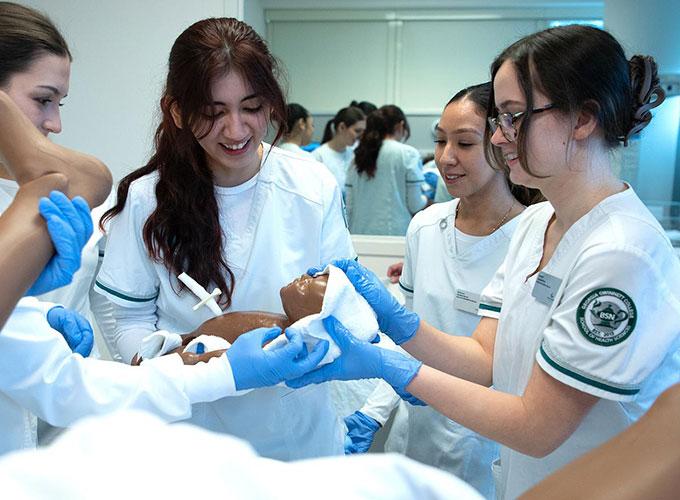
At Georgia Gwinnett College (GGC), students in the Bachelor of Science in Nursing program are gaining critical, hands-on experience in maternal and infant care. The program now features a state-of-the-art simulation mannequin, affectionately called Mama Ann, that realistically simulates childbirth and some complications of childbirth.
“It’s important for our students to know what to look for in their pregnant patients and newborns,” said Dr. Susan Dougherty, RN, DNP, assistant professor of nursing at GGC. “Lectures give students the background information and what to expect, but the childbirth simulation brings clarity to what they’ve learned.”
Mama Ann stands out for her highly lifelike capabilities, helping students feel as though they are responding to a real clinical situation. She is controlled by computer from a separate room, where faculty observe students in the simulated hospital room through a one-way mirror.
“Mama Ann’s skin is realistic, and students can feel her pulse in several places on her body just like a human,” said Thienthao Tran, simulations lab coordinator. “Students can feel the contractions and listen to the fetal heart rate. Mama Ann’s eyes blink and can dilate. Students learn to watch for symptoms that could signal complications and react to them quickly.”
In addition to routine labor and delivery scenarios, Mama Ann can simulate serious complications, including seizures, post-partum hemorrhage, eclampsia, abnormal fetal positions such as breech presentation, when the baby is positioned feet or buttocks first, and shoulder dystocia, when the baby’s shoulder becomes stuck after the head is delivered. The simulation can also include umbilical cord complications.
Research supports the effectiveness of this type of training. A January 2026 systematic review published in Cureus found that simulation-based training for nurses resulted in a significant reduction in adverse maternal and neonatal outcomes.
“By being able to recognize and react to any abnormalities the mother or infant experience before, during or after childbirth, our students will have the knowledge and hands-on skills to know what to do,” said Dougherty. “It’s important because nurses see OB clients in all parts of a hospital. They may encounter pregnant patients in the ED (emergency department) who were brought in as a result of an accident or other event, so they need to know how to handle those complications for the safety and well-being of the mother and infant.”
Doan Mallory, ’26, a Lawrenceville native, the decision to become a nurse was inspired by her mother, a nurse, and her younger sister.
“My younger sister is really allergic to nuts and has had a few near-death experiences because of it,” she said. “I want to know what to do and be that go-to person if something happens.”
Although she plans to work in critical care after graduation, the childbirth simulation has been invaluable.
“It’s one thing to look at pictures and read the words, but it’s a whole other thing when it’s happening in real time,” said Mallory. “I want to get as much practice as possible so I can build my proficiency and critical thinking skills. In this situation, you’re caring for two humans, so knowing and recognizing early warning signs is important.”
For Lawrenceville resident Nathan Samuel, ’26, nursing was a natural choice since both his parents are nurses. After graduation, he wants to work in a cardiovascular intensive care unit. Still, the maternal simulation left a lasting impression.
“It was nerve-racking at first,” he said. “This is a very vulnerable moment for the mother. You’re witnessing a miraculous process as part of the team taking care of two patients so there’s a lot you have to watch for. You have to have the heart and passion for nursing.”
For Dougherty, who has been an instructor for 30 years, the passion for teaching nursing students remains.
“Every time, about half the students will end up crying after delivering the baby,” she said. “They’re excited, fully engaged and caught up in applying what they’ve learned. It never gets old.”
Photo caption: Simonne Lipan, Jazlyn Sanchez, Allison Valdivia and Naomi Scumpieru Bogde work together as they learn how to clean up a newborn after delivery during the Mama Ann simulation on Thursday, Jan. 22, 2026 in the Allied Health and Sciences building's SIM labs at Georgia Gwinnett College. Photo courtesy Daniel Melograna/Georgia Gwinnett College
View and download Mama Ann simulation gallery photos and b-roll.