

As very young children, learning begins with recognizing numbers and letters. By third grade, students are reading books, opening worlds of wonder and knowledge. However, not all children make the transition to reading at grade level.
According to the Georgia Council on Literacy, 62% of third grade students are not reading proficiently. That number increases to 68% for fourth graders and 69% for eighth graders. This year, Georgia legislators are pushing for passage of the Georgia Early Literacy Act, designed to provide training and support for educators and screening for learning disabilities.
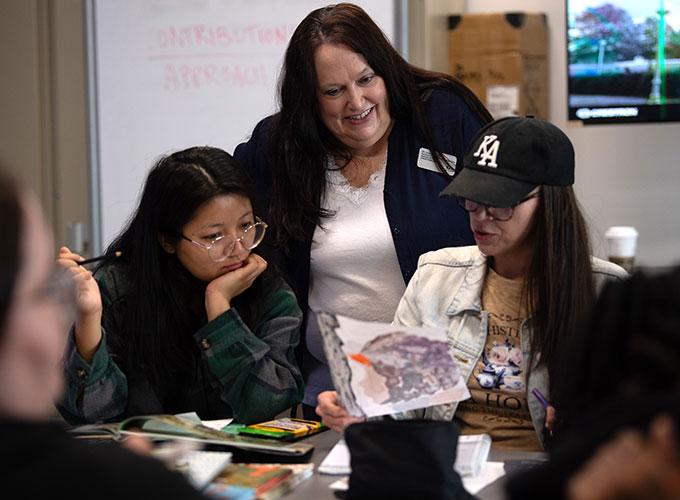
At Georgia Gwinnett College’s (GGC) School of Education, faculty are taking a proactive approach to preparing future teachers to address the issue.
“Our reading assessment class trains our teacher candidates how to identify reading difficulties early,” said Dr. Jamie Caudill, assistant professor of Literacy Education and chair of GGC’s Elementary Education and Literacy Department. “Once we pinpoint the need, our student candidates create individual lesson plans to help their students overcome those difficulties.”
For Snellville resident Crystal Coke, a junior majoring in elementary education at GGC, the classroom experience reinforces what she’s learning.
“Early detection is key,” she said. “Screening our students helps us determine if they have a reading deficiency. For me, I also like just talking with them. You’ll hear if they struggle with things like phonics.”
As a child, Coke’s favorite book was Llama Llama Red Pajama.
Kristina Jackson, a Braselton resident and junior elementary education major, says teaching is both challenging and rewarding.
“If you know what a child likes, you can use that interest to help them read and improve the areas that need work,” she said. “I’m here to help them and put smiles on their faces.”
Growing up, Jackson loved reading Are You My Mother? and The Rainbow Fish.
The reasons for low literacy vary, ranging from health issues to economic challenges.
“Some students may have developmental delays or undiagnosed conditions like dyslexia,” said Dr. Christine Reilly, associate professor of Literacy Education, Elementary Education and Literacy Department Chair. “Many times, students simply haven’t been exposed to reading or haven’t been read to regularly by a parent. It’s the teacher’s responsibility to provide explicit and systematic reading instruction that all students deserve in those early years of learning.”
Mary Langford, a Lilburn resident and junior majoring in elementary education, draws on her own experiences to support her students.
“I want my students to love learning,” she said. “I’ve found some students struggle with putting certain sounds together and reading sight words. By reading out loud to them, I’m showing how sounds come together. I want my students to feel confident that they can sit down and read a book out loud to someone in a space that feels safe and warm.”
As a child, Langford enjoyed Dr. Seuss books and later the Twilight and Percy Jackson series.
The importance of reading extends far beyond books.
“It comes down to comprehension,” said Reilly. “The more you read, the more you know. Reading helps students become critical thinkers and is essential for success in other academic subjects. It also builds empathy because students learn about others, which helps create a stronger classroom community.”
If reading deficiencies continue into adulthood, the consequences can be significant. According to the Adult Literacy 2023 Deloitte Report, nearly one million adults in Georgia have low literacy skills. The report also estimates that low literacy costs the state $1.2 billion annually through lost tax revenue, increased demand for social services and higher incarceration rates.
“Our literacy training is a hallmark program,” said Reilly. “The amount of field and teaching opportunities our candidates receive means they graduate confident and ready to make a positive impact in their own classrooms.”
Growing up, Caudill’s favorite books included Anne of Green Gables and Heidi. Reilly recalled loving Dr. Seuss books and the Nancy Drew mysteries.