
Bachelor of Science in Mathematics
On this page:
Cultivate Your Analytical Thinking
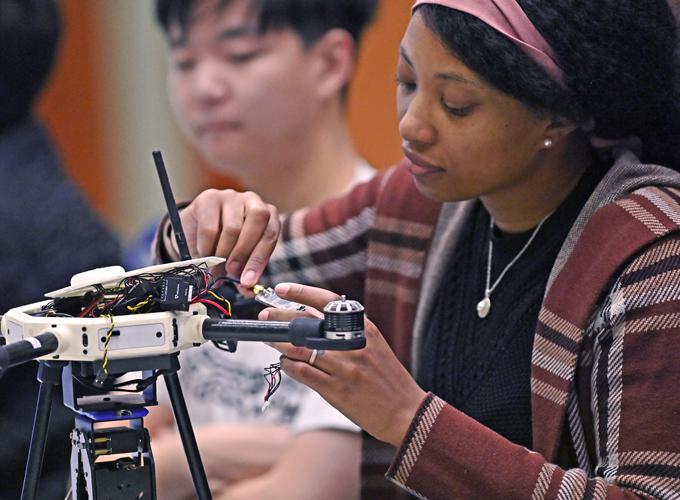
Mathematics offers a universal, indisputable means to communicate complex ideas, creating opportunities in almost every field – from business to healthcare, education, government, forensics and national security.
A bachelor's degree in mathematics prepares graduates for careers in business, industry and government, and for actuarial sciences, systems analysis and financial mathematics that are expected to grow rapidly.
Mathematics Concentrations
Mathematics is the study of quantity, structure, space, relation, change and various topics of pattern, form and entity and goes far beyond the traditional math topics studied in high school.
Mathematicians seek out patterns and other quantitative aspects of the entities they study, whether these entities are numbers, spaces, natural sciences, computers or abstract concepts. Mathematics students focus on the basics of analysis and algebra, together with topology, number theory, logic, numerical analysis, dynamica systems and differential equations.
This concentration is for students interested in the application of mathematics to another field or discipline. For example, applied mathematics in biology includes such topics as bioinformatics and combinatorial drug design that are used in the pharmaceutical industry. Graduates are prepared to enter graduate or professional school, or go directly into the workforce.
Course catalog requirements for applied mathematics concentration
This concentration is for students interested in teaching mathematics at the secondary level, grades 8-12. With a major in mathematics, they will also be prepared to enter the broader workforce and to pursue graduate or professional school.
Course catalog requirements for mathematics teacher certification
This concentration is for students interested in theoretical mathematics. Graduates will be prepared to enter graduate or professional school, or go directly into the workforce.
Course catalog requirements for pure mathematics concentration
Courses and Curriculum
Course examples for a mathematics degree (varies based on your chosen concentration):

Calculus 1

Linear Algebra
Calculus 1
Linear Algebra
Engaged Learning
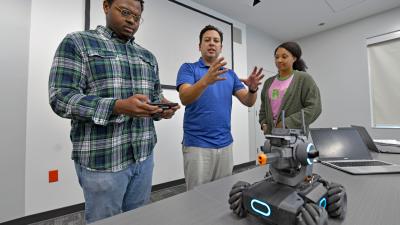
GGC fosters partnerships with local community organizations to provide tangible experiences that move portfolios to the top of the employment pile.
- Student/faculty research collaborations
- Technology Ambassadors Program (TAP)
- Academic conference presentations
- Internships
- Service learning
GGC also creates global engagement through study abroad opportunities.
Health Care, Engineering, Robotics Transfer Programs
Pre-advising and articulation agreements provide students with pathways to transfer credits and earn associates, master’s and doctorate degrees from other institutions.
Pre-advising
Interested in pursuing a graduate program or career in health care or engineering? Gain a competitive advantage with course choices, mentoring and research opportunities that start during your GGC freshman year.
Email prehealth@ggc.edu for more information.
Articulation Agreements
College articulation agreements are formal partnerships between GGC and other educational institutions that outline how credits earned at one institution will transfer to the other.
GGC participates in the Regents' Engineering Pathway (REP), which makes engineering programs more accessible to students throughout Georgia.
Participation in REP saves students money in tuition, fees, housing and meals, while attending college closer to home for the first two years of study. GGC professors also work closely with program coordinators from participating institutions to align program curriculum needs. This coordination assures a seamless transfer to the engineering school of choice to complete your bachelor's degree.
REP Transfer Options
- Georgia Institute of Technology
- Georgia Southern University
- Kennesaw State University
- Mercer University
- University of Georgia
REP Requirements
- Satisfy all courses required for admission of regular transfer students to any of the participating institutions.
- Complete all required math and science, as well as some engineering courses, at GGC (Listed in Appendix A of the REP Agreement (PDF) on the USG website).
- Review REP information and the REP Agreement (PDF) on the USG website for more information.
Admission requirements, including GPA, vary at the partner institutions. Visit the institution's website to review requirements.
GGC has developed an agreement with the New York Institute of Technology College of Osteopathic Medicine (NYITCOM) to offer eligible students early interview and admissions consideration. Program applicants must have completed their first two years of undergraduate education at GGC and meet and maintain the following criteria:
- Enter the program at the end of their second undergraduate year and apply at the end of their third year.
- Maintain the overall grade point average of 3.5
- Earn an MCAT score (on the MCAT taken no later than June 30 of the third academic year) at least equal to the mean MCAT score of the NYITCOM first-year class at the applicable NYITCOM campus for the year the student began the undergraduate study.
- Complete a minimum of 8 hours of biology (course/lab), 8 hours each of general chemistry and organic chemistry (course/lab), 8 hours of physics (course/lab), and 6 hours of English, with no grade below C in any of these courses or labs.
Note: Candidates will be held to the same rigorous admissions standards as other applicants, and final decisions will be solely at the discretion of NYITCOM.
Contact your faculty mentor or GGC’s School of Science and Technology (SSTadvising [at] ggc.edu (SSTadvising[at]ggc[dot]edu)) to learn more about this agreement or your intent to apply.
Learn more about the degree and admission requirements for the doctor of osteopathic medicine (DO) from the New York Institute of Technology College of Osteopathic Medicine.
GGC has developed an agreement with the Philadelphia College of Osteopathic Medicine (PCOM) to offer eligible students consideration from the faculty committee on admissions at PCOM provided students meet defined criteria including but not limited to the following:
- Declare their intent to apply for enrollment in the program during their sophomore year at GGC.
- Complete the undergraduate course requirements as listed in PCOM's catalog.
- Earn (on the 4.0 grading system) a grade point average of at least 3.25 through the end of junior year.
- Take the Medical College Admissions Test as early as possible but no later than the Fall of the senior year.
- Earn a minimum score of the fiftieth percentile (50%) in each section of the MCAT.
- Apply to PCOM through AACOMAS no later than Oct. 31 of the senior year and submit the PCOM supplemental application (with application fee) no later than Nov. 30 of the senior year.
- Submit a letter of recommendation from an osteopathic physician (DO).
Note: The final decision on admission to the DO program will be made by PCOM's faculty committee on admissions after the candidate has had a formal PCOM interview.
Contact your faculty mentor or GGC’s School of Science and Technology (SSTadvising [at] ggc.edu (SSTadvising[at]ggc[dot]edu)) to learn more about this agreement or your intent to apply.
Learn more about the degree and admission requirements of the doctor of osteopathic medicine (DO) from the Philadelphia College of Osteopathic Medicine.
GGC partners with the Philadelphia College of Osteopathic Medicine (PCOM) to offer eligible students majoring in biology and chemistry an opportunity to enter pharmacy school after completing their junior year at GGC. Following their second year of pharmacy school, eligible students receive their bachelor’s degree from GGC, then continue in the program to earn a doctorate from PCOM.
This agreement allows students to begin their careers early while saving tuition dollars.
Contact your faculty mentor or GGC’s School of Science and Technology (SSTadvising [at] ggc.edu (SSTadvising[at]ggc[dot]edu)) to determine if PharmD Early Assurance Program is right for you.
Learn more about degree and admission requirements for a doctor of pharmacy (PharmD) from the Philadelphia College of Osteopathic Medicine.
Georgia Gwinnett College partners with Kennesaw State University (KSU) to offer eligible GGC students a structured bridge pathway to an accelerated Master of Science in Intelligent Robotics Systems. Through this program, students may earn up to nine shared credit hours that apply toward both their GGC bachelor’s degree in STEM and the KSU master’s degree in intelligent robotics systems while completing undergraduate study.
The MS in Intelligent Robotics Systems focuses on advanced study in robotics, automation, artificial intelligence, machine learning and computer vision, with applications in areas such as manufacturing, autonomous systems and emerging technologies. This bridge agreement allows students to reduce time to the master’s degree while benefiting from coordinated advising and a streamlined transition to graduate study.
Contact your faculty mentor or GGC’s School of Science and Technology (SSTadvising [at] ggc.edu (SSTadvising[at]ggc[dot]edu)) to determine whether the GGC to KSU Bridge Program to an accelerated Master’s in Intelligent Robotics Systems (LINK) is right for you.
Learn more about the MS in Intelligent Robotics Systems and admission requirements at Kennesaw State University.
Minors, Certificates, Certifications
Add Value to Your Degree
Degree-enhancing minors, certificates and certifications add value to your degree. Available options range from the sciences, technology, history, political science, writing, the arts and more.
Contact Us
Contact us

Department Chair
Mathematics and Statistics Department Chair
Dincer Guler
dguler@ggc.edu
Related majors and programs

Cinema and Media Arts Production
Choose from three concentrations to earn a Bachelor of Arts in cinema and media arts production. Minor also available in film.

Management Information Systems
The management information systems major (B.S. in MIS) focuses on the interaction of people and technology in a business environment.

Health Science
Choose from two concentrations to earn a bachelor of science degree in health science.

Chemistry
Choose from three concentrations or teacher certification to earn a Bachelor of Science in chemistry. Minor also available.

Education

Environmental Science
Choose from two concentrations to earn a Bachelor of Science degree in environmental science.